Feb 23, 2026: Three contributions have advanced to the next stage of follow-on support to enhance the PoCs into a full stack integration!
Rolling dev calls: Join the weekly dev calls on Fridays at 3pm to discuss new ideas and learn how to contribute.
Nov 22, 2025: We are super excited to launch the first edition of the CoRE stack innovation challenge on geospatial programming!
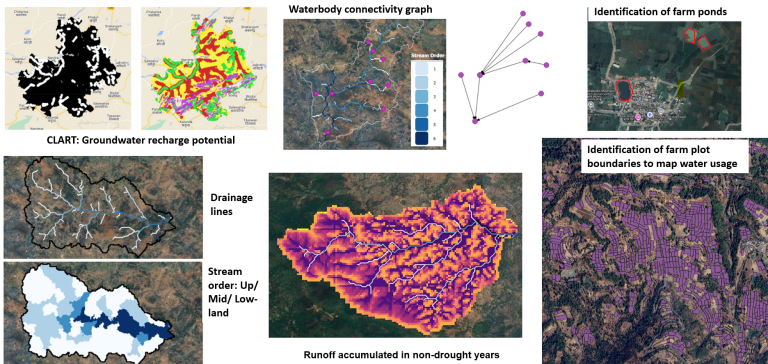
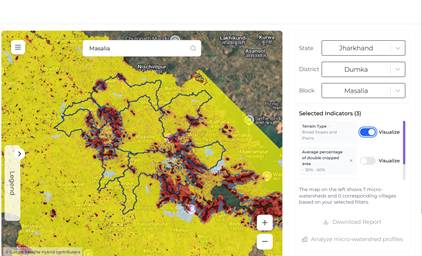
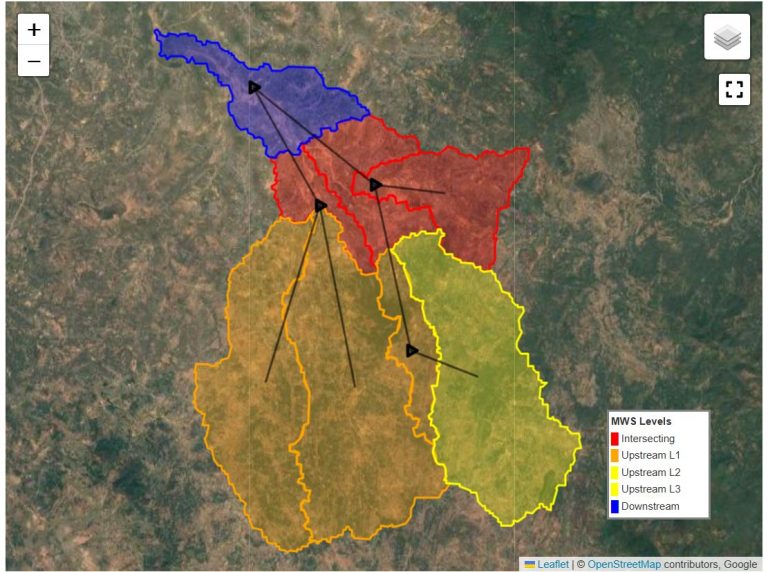
The CoRE stack is taking a novel approach to geospatial programming by providing ready-to-use pre-computed data of various landscape entities – micro-watersheds, waterbodies, forests, agroforestry plantations – organized in nested and connected spatial units, and populated with tons of datapoints about these entities to build a comprehensive place-based social-ecological understanding. Researchers and developers therefore do not need to worry about running complex geospatial workflows to generate all this data – we have done all that for you. You can rather just focus on asking the right questions from the data.
Check out the challenge details here.
The CoRE stack has been built in an extremely open and collaborative manner, and the challenge aims to do the same: Let us use this as an opportunity to not just come up with ideas, but also help point out bugs, solve these bugs, identify new APIs and datapoints that will help, and the engineering and maintainers team will do their best to do this quickly.
Who should participate
- Ecologists and hydrologists
- Researchers in water security and land use
- Geospatial engineers, data scientists, software developers
- NGOs, community technologists, and practitioners working with rural landscapes
- Students and open-source contributors interested in socio-ecological data
Challenge types
- Data Exploration & Insights: Use CoRE Stack layers to answer concrete landscape questions (comparative analyses, trend detection, counterfactuals). Deliver reproducible notebooks, maps, and concise interpretative notes for practitioners. Several such problems are outlined in the next section.
- Tooling, APIs & Developer Tools: Build developer-facing tools or libraries that make the CoRE Stack easier to use (client libraries, wrappers, STAC tools, boundary-clip and vectorization utilities, etc.).
- Data stories & UX Integrations: Create user-facing dashboards, chatbots, WhatsApp-shareable slide generators, or lightweight tools that practitioners and village communities can easily use to tell data-based stories. Focus on clarity, localization, and actionable outputs.
Timeline & milestones
- Launch: Nov 22, 2025
- Weekly developer community calls / mentorship: Fridays, 3-4pm
- Submission deadline:
Dec 31, 2025we have converted this to rolling contributions - Shortlist & demos:
Jan 15, 2026discussed in the weekly dev calls - Winners announced & prize distribution:
Jan 31, 2026converted to rolling contributions and evaluations
Prizes
- Cash prizes of the order of Rs 10,000 for exciting solutions plus merch from FOSS United for all participants.
- Additionally, mentorship sessions with domain experts in the CoRE stack network for top finalists.
- And opportunities to integrate winning work into the CoRE Stack ecosystem and technical support for adoption.
We also want to use this an opportunity to build an opensource community around the CoRE stack. Please join the Googlegroup and participate in weekly community calls on Fridays 3-4pm IST.