We are delighted to share that the CoRE stack has been selected for the AI for Climate Resilience programme, funded by Klarna. The programme was conceptualized and is run by Milkywire. The programme backs local innovators who use AI to help communities in low- and middle-income countries adapt to climate change. Our grant will help us build and test a stewardship financing model: a way to create a steady income stream for landscape stewards who look after their village landscapes.
Why stewardship needs funding of its own
While landscapes change over decades, the money that reaches them comes as projects of a few years only or one-time finance through government schemes. This may fund check dams, tree planting, or desilting of ponds, but it rarely includes components for long-term support of people who can ensure that the structures and plantations or restoration works are maintained.
That person is the landscape steward: somebody from the community, a community resource person or a community volunteer who lives in the area. Stewards help their community build a shared picture of its land and water. They help the Gram Sabha make a plan across commons, farms and forests, and link that plan to government schemes and CSR projects. Where stewards are present, structures are maintained, scheme money is spent on the right works, the gains last, and are equitably distributed.
Yet stewardship is almost never funded as an activity in itself. Fewer than one panchayat in ten has a steward today, and when a project ends, the steward usually has to leave for other work. The assets decay and the next project starts again from scratch.
We think this is the gap to close. By our estimate, a steward earning about ₹15,000 a month can enable, each year, around ₹15 lakh of additional income in the panchayat, 40,000 m³ of water conserved, 30 ha of land brought under drought protection, 300 tCO₂ sequestered and 80 ha of forest protected. Value on that scale deserves a steady income stream of its own.
The stewardship financing model
The idea is simple: when a steward’s contribution can be measured, it can be paid for, year after year.
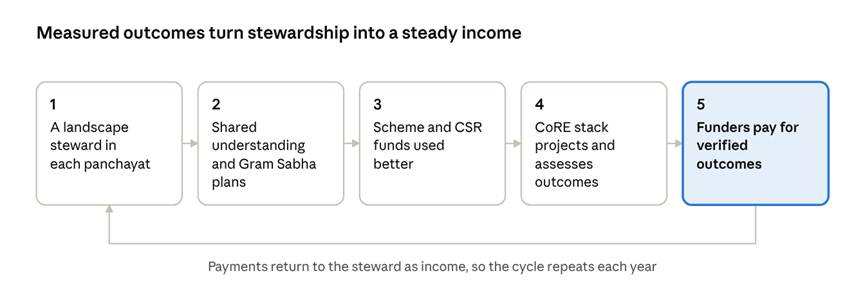
The stewardship financing cycle · 5 steps
The foundation is already in place. Commons Connect, the CoRE stack’s community-facing app, is in use in more than 2,000 villages by more than 20 civil society organisations and 500 stewards, who are building village-level natural resource management (NRM) plans with it. The new innovations will make it possible to project the impact that these plans will have (ex-ante), and assess the impact after a few years (ex-post).
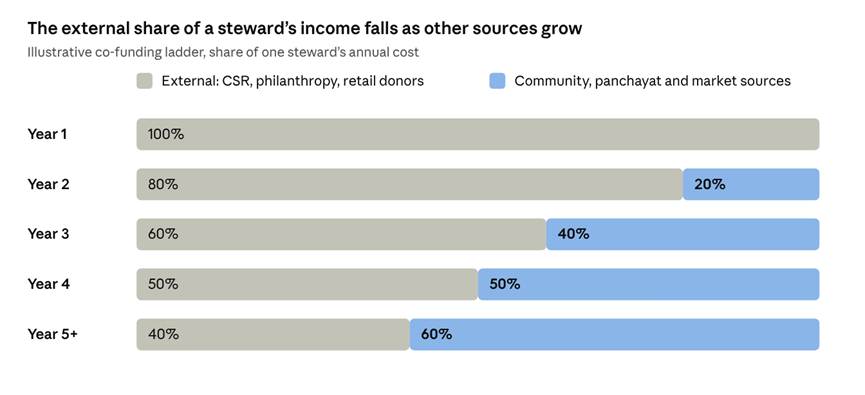
But an external funder should not carry a steward forever, eventually the owners of the place – the community – should take this up. A model we are conceptualizing is a ladder approach – a larger share of external funding where communities are new to the work, and move step by step towards a mix in which communities, panchayats and markets pay a growing share.
Measurement modules
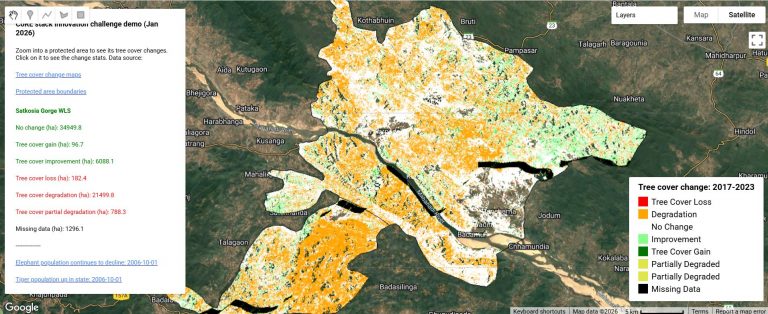
The grant will fund new CoRE stack modules to compute base metrics for any landscape, first as an ex-ante projection when a village plan is made, and then as an ex-post assessment once the work is done. For example:
- Groundwater created or saved (m³ a year): a water-balance model of the plan, checked against well levels.
- Area brought under drought protection (ha): change in crop moisture, greenness and cropping intensity compared with similar villages.
- Vegetation and biomass created (ha, tCO₂e): tree presence and canopy density over time.
- Forest area conserved (ha, tCO₂e): avoided degradation compared with similar unprotected forest.
- Ecological integrity (an index): soil erosivity, tree species diversity and soundscape diversity.
- Household income gain (₹): from changes in cropped area and yields, checked with household surveys.
- Equity of benefits: the share going to marginal and women farmers, and to Scheduled Caste and Scheduled Tribe households.
- Stewardship process: plans approved by Gram Sabhas, assets maintained, and scheme funds steered towards planned works.
Klarna grant
The funds will help catalyse the model in villages in Odisha and Rajasthan, working with FES as the lead partner and CommonsTech Foundation as the technology partner. Over the grant period we will:
- build the projection and assessment modules into the CoRE stack, and test them against what stewards and communities observe on the ground;
- create standard funder reports and highlight the importance of stewardship as a key activity in itself;
- test revenue channels with external and community funders; and
- share what works, and what does not, openly with the wider community.
The long run: a platform cooperative for landscape stewardship
Our longer-term vision is a funded steward in every rainfed and forest-fringe panchayat, connected together in a cooperative, and using the CoRE stack platform as a two-sided marketplace. On one side, communities and their stewards bring plans with outcomes that can be projected and verified. On the other, CSR teams, philanthropies, panchayats, individual donors fund those outcomes and follow their progress.
Revenue that flows through the platform would go to the stewards. A small share may pay for the technology platform itself, so the tools are owned and governed by the communities who use them. This could become the world’s first platform cooperative for landscape stewardship: open-source, transparent and community-owned, with stewards able to stay in their villages and shape their own landscapes.
The Klarna grant is the first step towards that. If you are a funder, a practitioner or a researcher who wants to help build it, we would love to hear from you.