September 2026
When Sai Rahul Poruri first met me some years ago and told me about FOSS United and their mission I felt an immediate affinity, but it was only now in this 2nd IndiaFOSS I attended that I figured why that was the case.
1. It’s because FOSS has a philosophy. Shree Kumar made it abundantly clear.
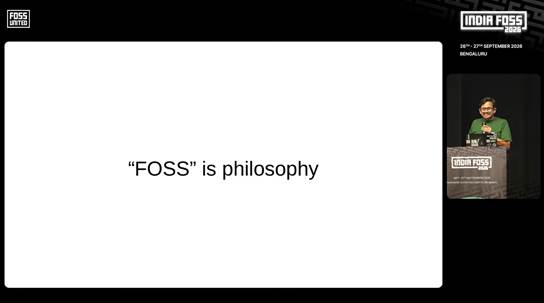
And the philosophy is that knowledge does not want to be trapped in silos, it wants to be free for everyone to use and build upon, as Stallman made it clear with the free software movement. Closed knowledge / information / code is unethical.
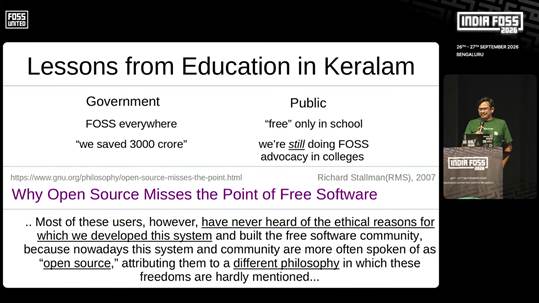
It is indeed a breath of fresh air to be in a place that has a philosophy about why it exists. Most other places inhabited by technologists, including academia, don’t think that deeply at all.
2. It’s also because a lot of FOSS is about problem solving – solving issues that you face yourselves or see around you, and you step up and solve them. So many talks started with just this – I faced a problem with flaky Internet access in my hostel and I built X, I faced a problem with Jupyter not being able to use concurrency well and I built Y, I felt that I wanted more control over Z and I built a more parameterized version…
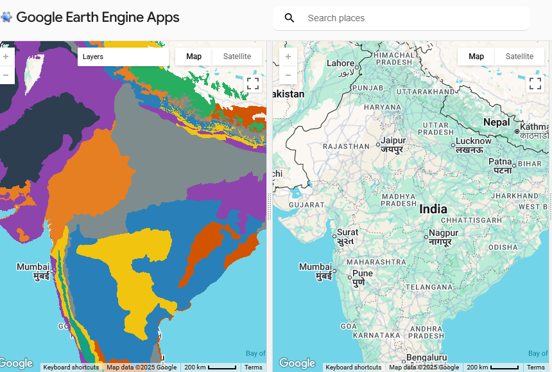
And that is exactly how the space of ICTs for development and sustainability works, and it forms the core of the CoRE stack: Spend time with rural communities to understand the problems they face and then solve them. Problem discovery.
3. Finally, when you put in one room problem solvers who are also philosophers you find the most exciting and inspiring set of people – who are solving stuff because they believe very deeply in something. What can be more delightful than being in their company.
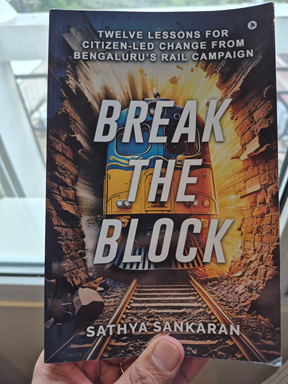
Sathya launched his book, Break the Block, on his journey of citizen-led change. Will be starting with it right after I post this blog!
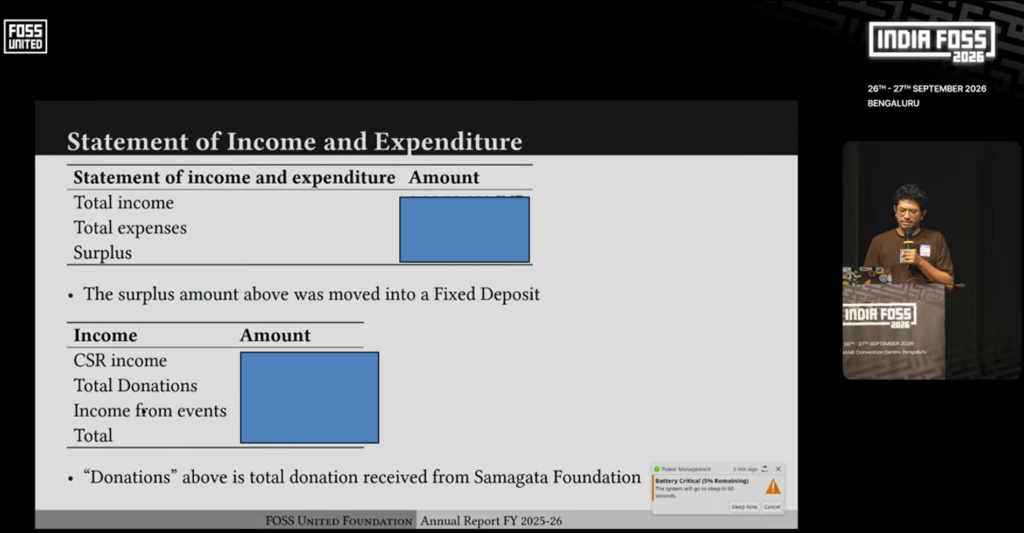
Rahul humbly presented the FOSS United updates and accounts to grow the FOSS philosophy. The details are online and transparently available, I have hidden it just to create some friction so that those interested can make the effort.
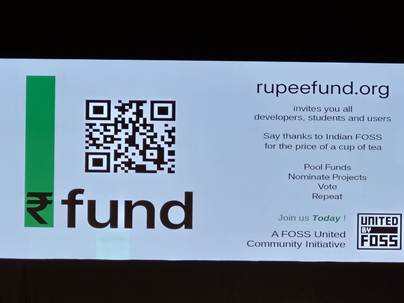
Shree launched the Rupee Fund to support FOSS maintainers.
And there was Kailash, Harsh (Bharat Digital), Tarunima (Tattle), ambika (Gooey.ai), Ansh, and so many more, highlighting that students had to discover this philosophy for themselves and take it forward. This fundamental doesn’t change even while AI transforms everything else.
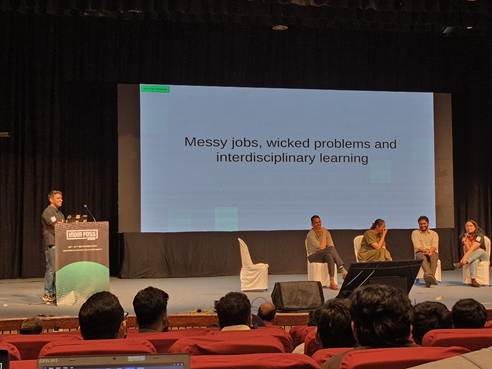
Now coming to the CoRE stack. We had a very nice discussion with on FOSS in Education with a couple of academics including KC from IIT Madras, Saket from IIT Bombay, Mohit from NIT-K, and others.
1. It was very nice to hear people talk about how the CoRE stack was able to involve students in building FOSS. I honestly hadn’t thought of it that way. Almost all the 40+ pipelines in the CoRE stack were indeed built by students but they, and me, always thought of it as projects that were then transitioned to the CommonsTech engineering team to productize them. “FOSS” did not typically enter our vocabulary, and perhaps that is why we’ve also been struggling with scaling this process.
- Projects are something that students work on passionately to learn and build and then move on to other projects.
- FOSS however is something that needs to be built and then also maintained. Viewing their contributions as FOSS can perhaps motivate students to stay engaged post their graduation and course timelines and continue to maintain what they built.
2. It was also nice to see an acknowledgement of the weekly and fortnightly dev calls we did during the 1st and 2nd innovation challenges, and more recently now with the FP Launchpad team, with students and professionals from across the country who got interested in building for and on the CoRE stack. But the realization from this experience is that it’s not sustainable and it’s hard to be productive as well. Distance poses a big problem. Calls are not easy for the CommonsTech team to understand the contributions being made and to give feedback, and students too face continuity challenges to keep at it while they move through exams and assignments and other programme deadlines.
What we need is to set up a distributed network of faculty who can work locally with students in their respective institutes and mentor students to make contributions to FOSS projects like the CoRE stack. I hope to work with Siddharth and Rahul from the FOSS United team to build a FOSS4Nature community. This might also be good timing because in the CoRE stack we are almost there with making it easier for people to contribute. We are about to announce soon:
- A simple three step process to set up your own dev environment to contribute to the CoRE stack: (1) a docker install of the CoRE stack backend, (2) git clone of the code, and (3) download of relevant base datasets from the CoRE stack STAC specs.
- If you find it too much of a learning curve to understand the CoRE stack architecture, you can package your pipeline as a docker container and just hand that over. The only requirement is that the geospatial datasets that your pipeline generates need to have STAC and STACD specs describing them.
- API v2 and MCP server through which you can query any of the datasets pan-India. A further extension is in progress to enable CoRE stack datasets to be instantiated anywhere in the world by moving from India-specific to global datasets of base layers.
Hope to work with KC and Anil (Cambridge) to build an academic network of core contributors to FOSS4Nature projects.
3. A challenge that everyone acknowledged was that FOSS can’t be built for free though, and that especially beyond student life most contributors would need some financial support. Initiatives like the Rupee Fund can go some way but clearly not all the way. The answer probably lies in making the software relevant for the market: If the CoRE stack, for example, ends up being relevant for companies like various agri-tech and climate-tech startups and enterprises then potentially we’ll see contributors emerge from within these spaces.
Manu (Arghyam) and I exchanged some good ideas on this today. We hope some of the field-scale work the CoRE stack is getting into with Google’s Anthrokrishi team will take us in that direction.
So, here are a few action items to keep in mind:
- Integrate the FOSS philosophy into mandatory curricula like professional ethics. And the FOSS methodology into courses on software engineering (like what Pankaj Jalote has been doing at IIIT Delhi) as well as tinkering assignments and projects in other courses on OS, networks, databases, ML, and project-based courses.
- Improve documentation of the three pathways to build for and on the CoRE stack: setting up a dev environment, supplying ready to pull dockers, and to use the APIs and datasets.
- Set up a FOSS4Nature academic network with faculty who can mentor students locally to contribute on relevant projects.
- Build affiliations with market enterprises to use the CoRE stack and contribute back to its development.
Finally, here is my talk: Computationalizing Landscapes: The CoRE stack data structure for social-ecological insights
Special callout to the CoRE Lens library built by Apoorva Kashyap, to be publicly announced in a bigger way very soon.